



Is your mind racing the second your head hits the pillow? You’re not alone. An estimated 50 to 70 million Americans suffer from sleep disorders, turning bedtime into a battleground of anxiety and frustration. What if you could gently guide your brain toward tranquility, without pills or potions? This is the promise of learning to meditate for sleep. It’s a simple, powerful way to quiet the noise, release the day’s tension, and welcome deep, restorative rest. If you’re ready to stop counting sheep and start getting real sleep, you’ve come to the right place.
Why Is Everyone Talking About Meditation for Sleep?
At its heart, meditation for sleep is a practice of focused relaxation that quiets the mind and body, making it easier to drift off. Think of it as a gentle transition from the high alert of your busy day to a state of calm readiness for rest. Unlike sleeping pills, which can have side effects and lead to dependency, meditation is a natural skill you can develop. It works with your body’s rhythms, not against them. The goal isn’t to force your mind to go blank – an impossible task! – but to observe your thoughts without getting swept away by them, like watching clouds pass in the sky.
This practice helps trigger what’s known as the “relaxation response,” a physiological state of deep rest that changes your body’s physical and emotional responses to stress. It’s the natural antidote to the “fight-or-flight” mode many of us are stuck in. By consciously slowing your breathing and focusing your attention, you’re sending a powerful signal to your entire system: it’s safe to power down now.
The Science-Backed Magic: How Meditation Rewires Your Brain for Rest
This isn’t just wishful thinking; there’s solid science behind why you should meditate for sleep. When you practice mindfulness, you activate your parasympathetic nervous system, which is responsible for the “rest and digest” functions. This leads to several key changes that promote sleep:
- Reduced Heart Rate: Your pulse slows to a calmer rhythm.
- Lower Blood Pressure: Your circulatory system gets a break from the day’s stressors.
- Increased Melatonin: Meditation can boost the production of the primary sleep hormone.
- Decreased Cortisol: Levels of the stress hormone cortisol are lowered.
A landmark 2015 study published in JAMA Internal Medicine found that mindfulness meditation resulted in significant improvements in sleep quality for older adults with moderate sleep disturbances. The group that practiced meditation experienced less insomnia, depression, and fatigue compared to a group that only received sleep hygiene education. Researchers believe this is because meditation helps regulate the brain regions that control sleep and emotional reactivity.
| Scientific Finding | Impact on Sleep | Supporting Evidence |
|---|---|---|
| Activates Parasympathetic Nervous System | Induces a state of calm, slows heart rate, and lowers blood pressure, preparing the body for rest. | Studies show meditation triggers the “relaxation response.” |
| Reduces Ruminative Thoughts | Helps you detach from the cycle of worrying and overthinking that often prevents sleep. | Research highlights meditation’s role in decreasing emotional reactivity. |
| Modulates Brain Waves | Encourages theta brainwaves, which are the same brainwaves present as you begin to fall asleep. | Neurological studies track brainwave changes during meditative states. |
| Increases Melatonin Levels | Boosts the natural production of the hormone that regulates the sleep-wake cycle. | Evidence suggests meditation can influence key sleep-related hormones. |

Getting Started: Creating Your Perfect Sleep Sanctuary
Before you dive into the techniques, setting the stage is crucial. You don’t need a fancy setup, just a little intention. Your bedroom should signal to your brain that it’s time for rest, not work or worry. Think of it as creating a cozy, welcoming nest for sleep.
First, dim the lights. Bright lights, especially the blue light from screens, can interfere with your body’s melatonin production. Try to put your phone away at least an hour before bed. If you use it for a guided meditation, set it up, turn the screen face down, and don’t look at it again. Next, ensure your room is a comfortable temperature – slightly cool is often best for sleep. Finally, make sure you’re physically comfortable in your bed. You can lie down or sit up, whichever feels most relaxing. The key is to minimize distractions and create an environment of peace.
A common question is: “What if I can’t clear my mind?” That’s completely normal! The goal of meditation isn’t an empty mind, but a focused one. When a thought pops up, simply acknowledge it without judgment and gently guide your attention back to your breath or the meditation guide. It’s a practice, not a performance.
The 7 Best Guided Meditations to Help You Fall Asleep Fast
Ready to find the technique that works for you? Each of these meditations offers a unique pathway to peace. Experiment with them to discover your favorite way to unwind.
1. The Body Scan Meditation: A Journey from Toes to Tranquility
This is a fantastic starting point for anyone new to meditation. The body scan involves bringing gentle, non-judgmental awareness to each part of your body, one by one. You’re not trying to change anything, just notice the sensations present.
How to do it: Lie comfortably on your back. Starting with your toes, bring your full attention to them. Notice any feelings – warmth, coolness, tingling, pressure. After a few breaths, move your awareness up to your feet, then your ankles, calves, and so on, slowly making your way up to the crown of your head. This practice anchors you in your physical self, making it difficult for your mind to get caught up in anxious thought loops. Many people find they fall asleep before they even finish the scan!
2. Mindful Breathing: Your Simplest Tool for Calm
Your breath is always with you, making it the perfect anchor for your attention. Mindful breathing meditation involves focusing on the physical sensation of your breath entering and leaving your body.
A simple technique to try is the 4-7-8 method:
- Inhale quietly through your nose for a count of four.
- Hold your breath for a count of seven.
- Exhale completely through your mouth with a whooshing sound for a count of eight.
- Repeat this cycle three to four times.
This type of deep, diaphragmatic breathing stimulates the vagus nerve, which helps shift your body into a state of relaxation. It’s a surprisingly powerful way to calm your nervous system almost instantly.
3. Guided Visualization: Paint a Picture of Peace
If you’re a visual person, this technique can feel like a mini-vacation for your mind. Guided visualization involves creating a detailed, peaceful scene in your imagination and immersing yourself in it.
How to practice: Close your eyes and imagine a place where you feel completely safe and relaxed. It could be a quiet beach at sunset, a lush forest, or even just floating on a soft cloud. Engage all your senses. What do you see? What sounds do you hear? Can you feel a gentle breeze or the warmth of the sun? By focusing your mind on this serene imagery, you leave less room for worries and anxieties to take hold.
4. Loving-Kindness Meditation: Wrap Yourself in Warmth
Sometimes, what keeps us awake is a harsh inner critic or feelings of stress and frustration. Loving-kindness meditation, also known as Metta, helps dissolve these feelings by cultivating an attitude of warmth and care toward yourself and others.
How to do it: While breathing gently, silently repeat a series of phrases. Start with yourself: “May I be happy. May I be safe. May I be peaceful and at ease.” After a few minutes, extend these wishes to someone you love, then to a neutral person, and eventually to all living beings. This practice can reduce the anxiety and emotional reactivity that often fuel insomnia.
5. Progressive Muscle Relaxation (PMR): Melt Away Physical Tension
Stress doesn’t just live in your head; it gets stored in your body as physical tension. PMR is a technique that involves systematically tensing and then releasing different muscle groups.
How to practice: Lying in bed, start with your feet. Tense the muscles in your feet and toes, hold for five seconds, and then release completely, noticing the feeling of relaxation that follows. Work your way up your body – calves, thighs, glutes, abdomen, arms, shoulders, and face – tensing and releasing each muscle group. This deep physical release sends a powerful message to your brain that it’s time to let go and rest.
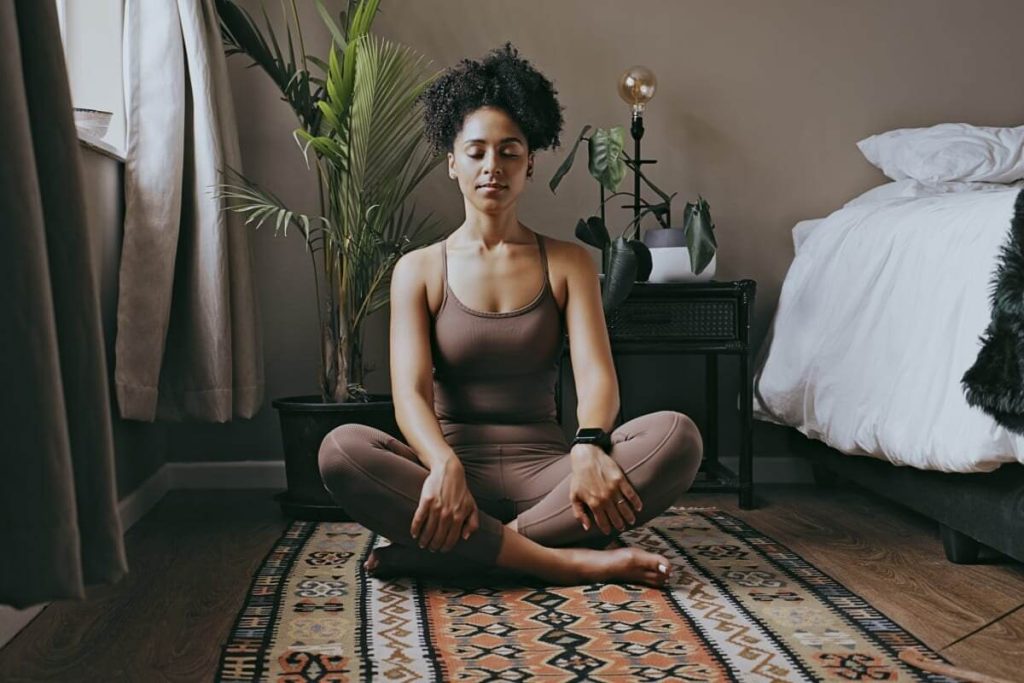
6. Mantra Meditation: A Soothing Sound for a Busy Mind
For a mind that just won’t quit, a mantra can be an incredibly effective tool. A mantra is a simple, soothing word or phrase that you repeat silently to yourself.
How to do it: Choose a word that evokes a sense of calm for you, such as “peace,” “calm,” “relax,” or even just the sound “Om.” As you lie in bed, repeat your mantra silently with each exhale. When you notice your mind has wandered (which it will!), gently and without judgment, return your focus to the mantra. The repetition gives your busy mind a simple job to do, preventing it from spiraling into more complex, stressful thoughts.
7. Yoga Nidra: The Art of “Yogic Sleep”
Yoga Nidra is a powerful guided meditation that leads you into a state of consciousness between waking and sleeping. While your body is deeply relaxed, your mind remains aware and calm.
How it works: Typically, you’ll listen to a guided audio track that leads you through a specific sequence, often including a body scan, breath awareness, and visualizations. It’s designed to systematically relax you on every level – physical, mental, and emotional. Many practitioners report that a 30-minute Yoga Nidra session can feel as restorative as several hours of conventional sleep.
Which Meditation Style Is Right for You?
Feeling a bit overwhelmed by the options? Don’t be. The best technique is the one you’ll actually do. Here’s a quick guide to help you choose a starting point based on what’s keeping you up at night.
| If your problem is… | Try this meditation first… | Why it works… |
|---|---|---|
| Racing, anxious thoughts | Mindful Breathing or Mantra Meditation | Gives your mind a simple, repetitive focus point, crowding out worries. |
| Physical tension and restlessness | Progressive Muscle Relaxation or Body Scan | Directly addresses and releases stored physical stress in the body. |
| A creative, wandering mind | Guided Visualization | Uses your imagination constructively to create a peaceful mental state. |
| Feelings of stress or self-criticism | Loving-Kindness Meditation | Fosters a sense of emotional warmth and safety, counteracting anxiety. |
| Complete exhaustion but can’t switch off | Yoga Nidra | Induces a state of deep, conscious rest that can be profoundly restorative. |
Common Roadblocks and How to Navigate Them
Starting a new practice isn’t always a straight line. It’s normal to hit a few bumps along the way. The most important thing is to be patient and kind to yourself.
- “I keep falling asleep!” If you’re meditating in bed to fall asleep, this is the goal! But if you fall asleep too quickly and feel you’re not getting the mental benefits, that’s okay too. It’s a sign your body desperately needs rest. Don’t fight it.
- “I feel restless and impatient.” This is very common, especially in our fast-paced world. Start with shorter sessions, just 3-5 minutes, and gradually increase the time. Remember, noticing your restlessness is a form of mindfulness.
- “I’m not doing it right.” There is no “perfect” way to meditate. The practice is simply about returning your attention, again and again, whenever it wanders. Every time you notice your mind has drifted and you gently bring it back, you are strengthening your mindfulness muscle.
Conclusion: Your Invitation to Peaceful Nights
Tossing and turning doesn’t have to be your nightly reality. By learning to meditate for sleep, you are giving yourself a priceless gift: the ability to quiet your own mind, soothe your own body, and unlock the deep, restorative rest you deserve. It’s not a quick fix, but a gentle, compassionate practice that builds over time. Start tonight. Choose one technique, lie down, press play, and just breathe. You are just a few quiet moments away from a better night’s sleep.
If this article has helped you, please share your thoughts in the comments below! Your experience could be the encouragement someone else needs to finally find their path to peaceful nights.
References:
